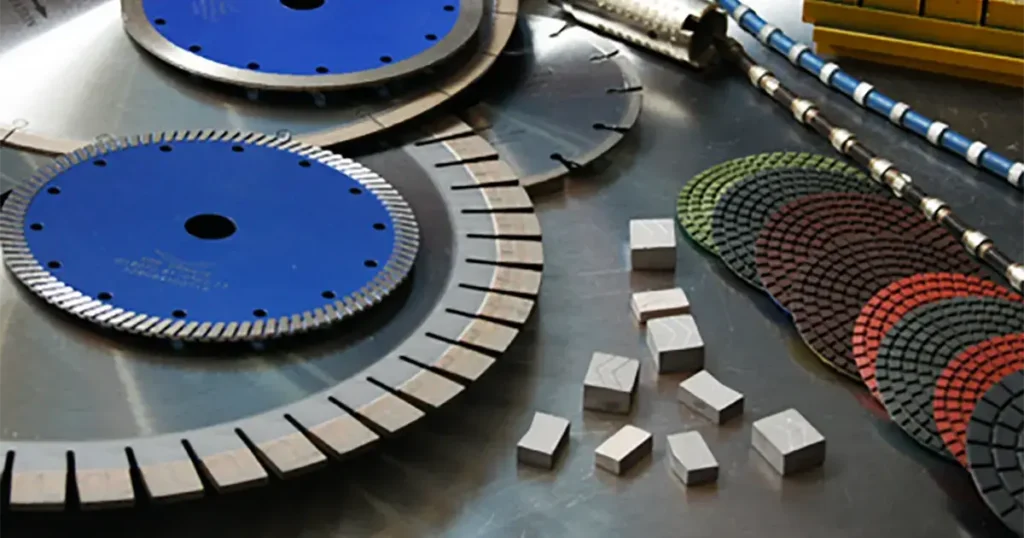
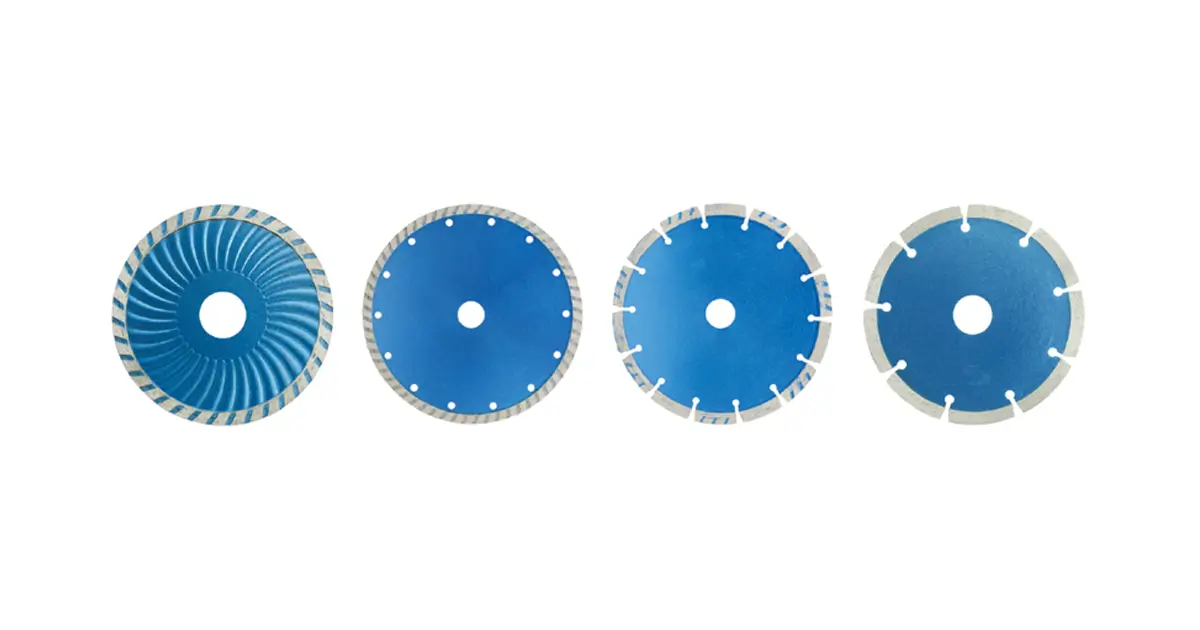
The sintering process is a crucial step in diamond saw blade production, as it impacts both the quality and production capacity of the diamond saw blades. For a long time, the overall sintering of diamond saw blades has been carried out under hydrogen protection without pressure, which has limited the improvement of product quality. Some companies use intermediate frequency induction sintering technology to significantly improve the quality of saw blades, but this method is limited in mass production and consumes a lot of energy.
In the 1990s, South Korea developed a saw blade integrated hot pressing sintering furnace, which realized the saw blade integrated hot pressing sintering process, increased the variety and quality of saw blades, and made the products popular in the international market.
As a diamond tool manufacturer, Diawe Tools discusses hot-pressed sintered saw blades and manufacturing processes/technologies here.
What are Hot-pressed Sintered Diamond Saw Blades?
The hot pressing sintering process involves mixing diamond particles with metal matrix powder and applying high pressure through a mold at high temperature to cause physical thermal diffusion bonding and chemical reaction between diamond and alloy powder, resulting in rapid bonding and molding.
The diamond saw blade produced by this hot pressing sintering process is called a hot-pressed sintered saw blade.
Advantages of Hot-pressed Sintered Diamond Saw Blades
Hot-pressed sintered diamond saw blades have the following advantages:
- The blade has high density and a long service life. Under high-temperature, high-pressure production conditions, thermal diffusion occurs between the metal matrix and diamond powder, resulting in smaller gaps and higher blade density. At the same time, the metal matrix undergoes chemical reactions at high temperatures (depending on the formula design), making the saw blade and blade more integrated. The metal binder has a strong “holding force ability” on diamond, so the service life of hot-pressed sintered diamond saw blades is longer, 20% -35% higher than that of ordinary cold-pressed products.
- Excellent self-sharpness. The high-temperature sintering temperature is usually between 600℃ and 1200℃, and the grade of diamond used is relatively high. Diamond is harder and will not carbonize at high temperatures. The produced saw blades can cut various high-hardness materials. When cutting high-hardness and brittle materials such as rock slabs, microcrystalline stones, vitrified bricks, reinforced concrete, etc., high-grade diamonds have better sharpness. After long-term cutting, the passivated diamonds of the saw blade can naturally fall off, exposing new sharp edges. Good self-sharpening ability can adapt to long-term cutting, with a flat and beautiful cutting surface.
- Higher security. Due to the better bonding between the components of the saw blade body and the stronger blade head, it is less prone to tooth breakage and breakage during high-speed cutting operations, avoiding injuries to personnel from flying objects.
- Environmental protection and high cost-effectiveness. Hot-pressed sintered diamond saw blades can fully utilize diamonds, reduce material waste, and achieve certain environmental protection goals. The product has a wide range of applications and a long lifespan. Although the unit price is higher than that of ordinary saw blades, the overall cost of use is lower, and the cost-effectiveness is higher.
The Key Manufacturing Technologies of Hot-pressed Sintered Saw Blades
There are many types of hot-pressed sintered diamond saw blades, and different cutting objects require different blade structures and material designs/formulas.
Mass Production and Stable Quality of Saw Blade Blank
At present, there are various diamond saw blade products with a wide range of specifications and types, which are the most common products in the hardware market, corresponding to a variety of saw blade blanks. Therefore, many diamond tool factories try to produce their own saw blade blanks, but their production capacity and types are limited, and ultimately they must rely on the supply chain to produce on a large scale through professional saw blade blank manufacturers.
Cold Pressing Process
For a long time, the cold pressing of saw blades has been carried out manually by weighing and loading materials, using a four-column simple cold press machine for manual pressing and film removal process. Workers have high labor intensity and low efficiency. It is difficult to ensure the accuracy of compression density, thickness, and size. To improve efficiency, one machine with multiple workstations is adopted. To ensure the safety of workers, photoelectric signal devices are installed on the cold press machine to prevent personal accidents. In order to facilitate demolding, measures such as configuring an automatic saw blade peeling device are taken. In short, the cold pressing process is mainly completed by manual labor.
In recent years, diamond tool equipment manufacturers have made breakthroughs in this area, with some equipment manufacturers producing semi-automatic and fully automatic diamond saw blade forming machines.
The semi-automatic and fully automatic diamond saw blade forming machines can achieve continuous semi-automatic or fully automatic pressing and forming of diamond saw blades, suitable for pressing Ø 105- 450 mm diamond saw blades. The production efficiency is high, the density of the pressed saw blades is uniform, the geometric dimensions are stable, and it can reduce the labor intensity of workers and reduce the investment of manpower.
Choose a Suitable Hot Press Sintering Furnace
The design and selection of hot press sintering furnace should consider the following factors:
- Control System
- Atmosphere Protection
- Pressure Performance
- Selection of High-quality Steel Molds
- Furnace Size and Structure
- Safety Sealing Performance
Improve Sintering Process
The sintering process refers to the setting and control of three factors: temperature, pressure, and time during the sintering process. This involves controlling the rate of temperature rise, sintering temperature, holding time, and temperature during cooling out of the furnace during the sintering process, as well as controlling the pressure application rate and holding time.
There are two sintering methods:
- The saw blade is first cold pressed to form a continuous saw blade or a segmented saw blade, and then loaded into a steel mold for hot pressing and sintering to form a continuous turbo saw blade or a segmented turbo saw blade.
- The saw blade is initially cold-pressed into a continuous turbo saw blade or segmented saw blade, then loaded into a steel mold for hot pressing and sintering to achieve final formation.
The first process mentioned above aims to improve the efficiency of cold forming and reduce the difficulty of cold forming saw blades. The second process aims to reduce the workload of the mold assembly process, ensure the accuracy of the hot-pressed segment profile of the saw blade, and improve the service life of the hot-pressed mold.
There are basically two types of saw blade sintering processes: one is to apply full pressure during the insulation process, and the other is to apply segmented pressure protection after a period of insulation. In order to improve sintering efficiency and yield, and reduce energy consumption, the method of hot in and hot out of the furnace is basically adopted. The coreless sintering furnace adopts nitrogen protection. After safe discharge, the entire furnace saw blade is immediately sealed with a protective liner and protected by an atmosphere. Using hydrogen gas with furnace liner sintering is beneficial for improving the quality of saw blades.
Quality Control and Quality Inspection
In the production process, firstly, it is necessary to ensure accurate material weighing. The saw blade is sensitive to the amount of material used during hot pressing and sintering, resulting in low material quantity, insufficient pressing and sintering density, easy tooth loss, and low strength; When the amount of material is large, low-melting-point metal components are prone to overflow.
Secondly, it is necessary to protect the quality of cold pressing. During demolding, it is easy to damage the raw material during forming. An automatic demolding cold press machine or a saw blade automatic cold pressing machine can be used. Pay attention to the process of loading molds into the furnace, as the number of molds produced by sintering small saw blades will affect the size of the finished product. When sintering a stack of saw blades, the thickness error of the saw blades mainly comes from the precision error of the mold processing. When multiple stacks are assembled and sintered, the height of each stack is not consistent, which can easily cause uneven compression and lead to unstable saw blade quality. In addition, the positioning accuracy of the upper and lower molds is very important; otherwise, it can easily cause misalignment of the saw blade heads.
The following measures can be taken for the inspection and control of saw blade quality:
- After the saw blade is fired, the quality of the saw blade can be checked based on the sound. If the sound is clear and there is no dull or hoarse sound, it can be basically judged that there are no obvious cracks in the saw blade, and the blade head is tightly bonded to the substrate.
- Sampling inspection of the saw blade’s segment hardness and geometric dimensions.
- Use a torque wrench to test the bonding strength of the segments according to customer requirements.
- Inspect the distribution and damage of diamond on the fracture surface and the condition of the matrix metal binder under a microscope.
- Test the saw blade on the cutting equipment to determine its sharpness, wear rate, cutting current, and lifespan.